How can AI help communities respond to a changing climate?
In the next article of our Explore CHIA Research series, we meet Dr Ramit Debnath and his Collective Intelligence and Design Group. Their work explores how AI can support climate decisions that reflect people’s needs, knowledge and experiences, offering a window into CHIA’s wider AI for Sustainability Programme.
Climate action involves decisions about how we live, what we build and how we prepare for extreme weather. As the climate warms, heatwaves, floods and droughts are becoming more frequent and intense, and they increasingly interact with one another and with energy, food and social systems to create compound risks. At CHIA, Ramit and his colleagues combine AI, environmental data and research on human behaviour to help understand these complex interactions and inform how societies respond.

“How can we shape AI that supports environmental and climate justice outcomes where humans are at the centre of decision making?”
From everyday choices to global risks
The team works across several scales, connecting individual decisions with the systems that shape life in cities and across the world.
At the everyday level, researchers explore how people make low-carbon choices and how the design of digital tools could help people use generative AI more efficiently.
At the city level, they investigate how AI can connect carbon emissions data with the way cities function, helping identify routes towards decarbonisation. They also study how local circumstances and cultural values influence people’s willingness and ability to change their behaviour.
At the global level, the team combines a wide range of data, from satellite imagery to crowdsourced public opinion, with machine learning, neural networks and other AI methods. The aim is to understand how extreme weather and environmental change affect people and what happens when these shocks overlap and reinforce one another. Those insights inform policies designed to benefit communities worldwide.
The team also uses satellite data and AI to work towards mapping every river and hydropower plant in the world, assessing the ecological risks alongside the benefits of hydropower development. They also investigate how extreme heat affects people and infrastructure.

What makes a heatwave deadly?
In a study published in Nature Communications, Ramit and colleagues used machine learning to analyse more than 125,000 heatwave events across 140 cities over 34 years. They found that temperature and humidity alone could not reliably distinguish deadly heatwaves from those without reported deaths.
Their model considered how sharply temperatures had risen compared with recent local conditions, alongside indicators of population health and vulnerability. The findings suggest that dangerous heat depends partly on what people are accustomed to and their ability to adapt. This could help inform heat warnings that better reflect the risks facing different communities.
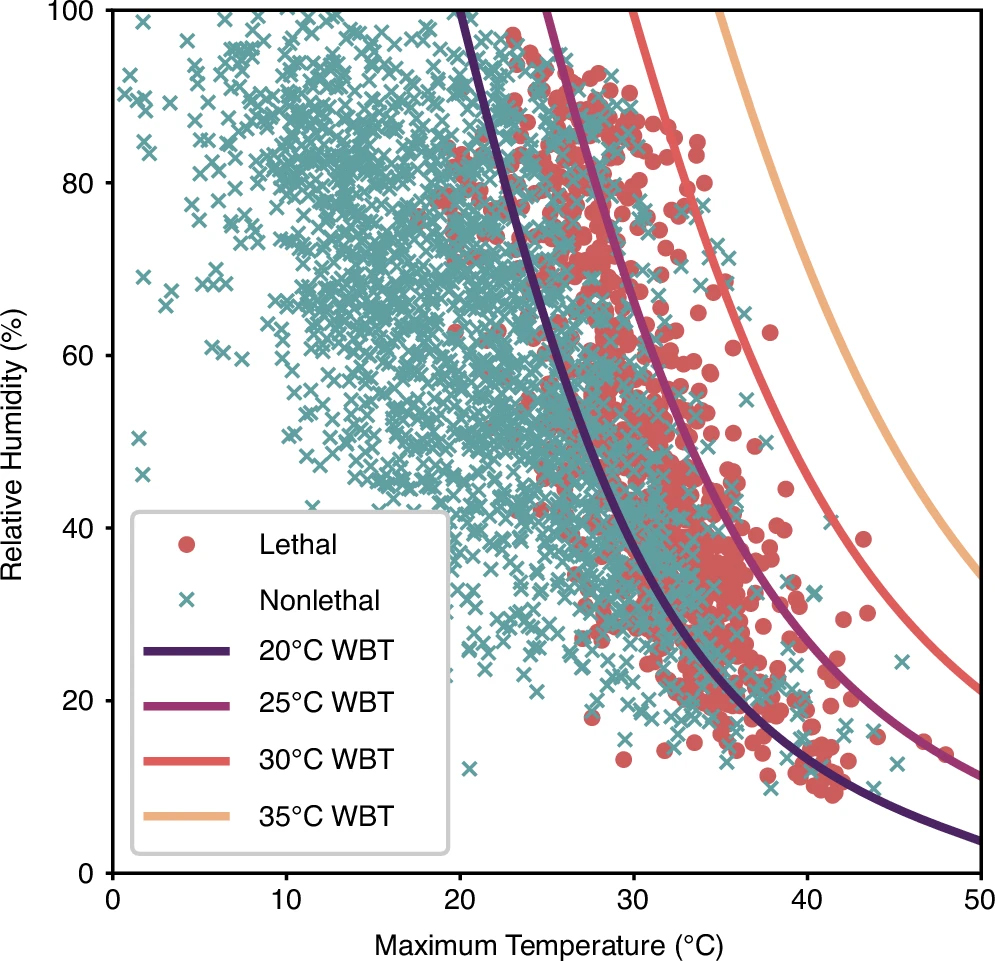
Deadly heatwaves (red circles) overlap with heatwaves without reported deaths (blue crosses), showing why temperature and humidity alone cannot determine the danger. Only a sample of events without reported deaths is shown. (Image: Rouse et al., Nature Communications (2026), Figure 1, CC BY 4.0.)
How heatwaves affect food and livelihoods
PhD researcher Anqi Liu investigates how heatwaves and power cuts affect food systems in West Africa, from household meals to the businesses that store and sell food.

She combines household and business surveys with weather records. Satellite images of lights at night help identify possible blackouts, providing a check alongside people’s reports. She also uses machine learning to account for differences between households, such as wealth, helping to separate genuine effects of heat and power cuts from patterns that are just coincidence.
Anqi’s findings so far suggest that heatwaves strain power grids, but most resulting blackouts are too short to spoil food in household fridges. Larger effects appear to come from families changing what they buy and eat, often choosing foods that keep without refrigeration.
“Businesses that store and sell food appear to bear more of the cost of power cuts than households do.”
These emerging findings could help governments target investment in power grids and cold storage, while identifying everyday choices that climate models need to capture.

Understanding how climate action spreads
How people respond to climate information is central to PhD researcher Tianzhu Qin’s work. He studies why the same message can prompt different reactions and how people influence one another.
“The broader goal is to understand what helps people move from awareness of a climate problem towards taking action.”
He uses large language models within computer simulations of groups. Individual AI agents represent simulated people, allowing him to explore how their reactions and interactions shape the wider response.

He hopes to test how messages are received by people with different perspectives, and how interactions affect collective action. Crucially, he will also assess how well the simulations reflect real human behaviour and where they fall short. This will help establish when they can provide useful evidence for climate communication.
Whose future does AI imagine?
PhD researcher and Gates Scholar Abdullah Safir asks whose knowledge AI systems recognise.
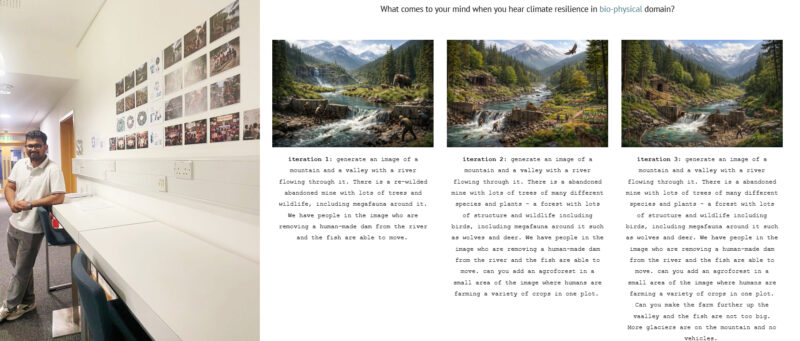
Working with artists, creative practitioners and other users in Bangladesh, he explores how generative AI can better reflect diverse cultures and ways of understanding the world.
In workshops in Cambridge and Dhaka, climate practitioners used a customised AI tool to turn their ideas about desirable climate futures into images. Drawing on their lived experience, participants helped researchers explore how these visions differed across settings. Selected outputs feature in CRASSH’s Knowledge in a Fractured World exhibition.
“The limited availability of data on non-Western imagery and artistic practices partly explains their underrepresentation in AI systems.”
His research also examines the historical inequalities behind these gaps. His aim is to develop guidance for AI design that respects different knowledge traditions and the communities using it.
From understanding to practical support
Across these projects, reliable data and human expertise are essential. Climate impacts are experienced locally, and community knowledge can reveal circumstances missing from large datasets. Combining these perspectives helps researchers question AI’s assumptions and understand where its conclusions may fall short.
Looking ahead, Ramit’s team is working with Caltech to investigate biases in AI-generated climate information and how such information can amplify social and political risks. A collaboration with Stanford University is developing an LLM-powered flood early-warning system in Bangladesh, intended to send text and voice messages to people in vulnerable areas to support safer evacuation and flood adaptation.

Research informing decisions
The team works with intergovernmental organisations, governments and financial institutions to inform decisions about reducing emissions and adapting to climate change. Its research provides evidence of climate impacts on individuals, cities and countries, helping shape policies that protect lives, health and livelihoods.
Organisations the team works with include the Asian Development Bank (ADB), the Intergovernmental Panel on Climate Change (IPCC), Boston Consulting Group (BCG), the International Monetary Fund (IMF), C40 Cities, the International Energy Agency and the UK Government. Through the Energy Policy Research Group (EPRG), the team also helps translate findings for UK energy and climate decision-makers, including Ofgem, the National Energy System Operator (NESO) and the Climate Change Committee (CCC).
Building on this work, Ramit recently co-founded the University of Cambridge’s Centre for Space, Earth and Energy (CSEE) with Dr Kamiar Mohaddes of Cambridge Judge Business School. The Centre brings together economists, Earth and space scientists and data scientists to deepen engagement with government, industry, finance and civil society, helping to turn rigorous evidence into decisions for a sustainable, flourishing planet.
Explore AI for Sustainability at CHIA
The AI for Sustainability Programme explores how AI can help us understand environmental change and support decisions about how to respond. Explore the programme to discover more of the people and projects working on these questions.
References
- Collective Intelligence and Design Group
- Reclassifying lethal heat, Nature Communications, 2026.
- Resisting epistemic loss in AI image generation, Patterns, 2026.
- Further reading: Enabling people-centric climate action using human-in-the-loop artificial intelligence: a review, Current Opinion in Behavioral Sciences, 2025.