How do thoughts become words?
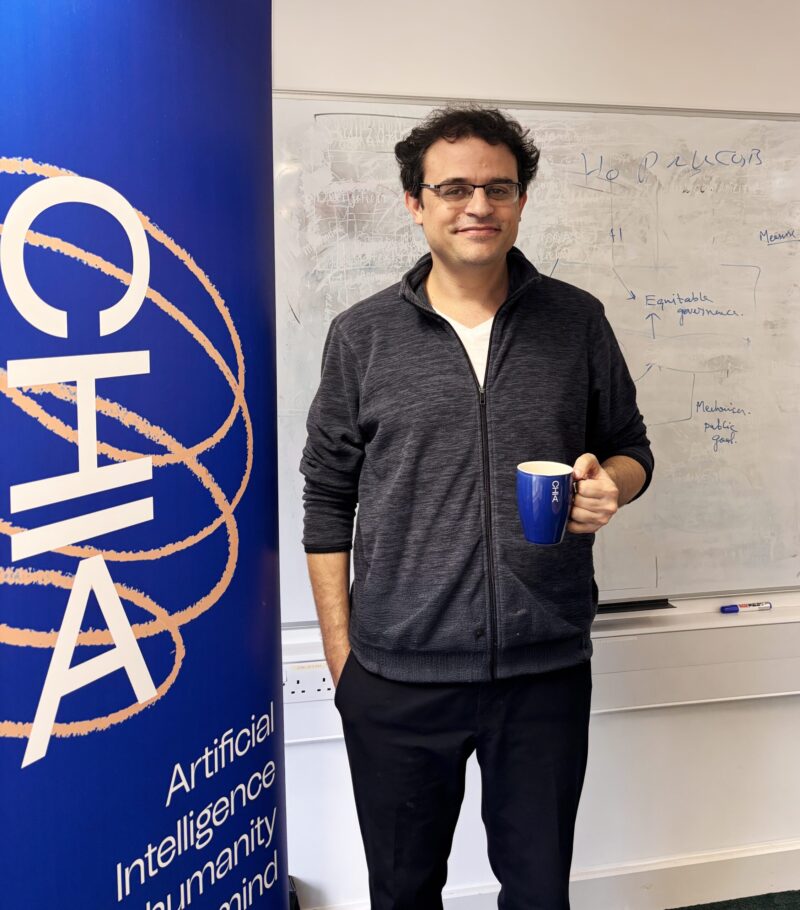
In the first article of our Explore CHIA Research series, we meet Ariel Goldstein and his Deep Cognition Lab to explore how we choose what to say, how conversations shape our thinking, and what AI can reveal about the human mind. Their work offers a window into CHIA’s wider Cognitive AI Programme.
We speak every day, often without considering how we do it. We choose words, introduce ideas and respond to other people. Yet we are still learning how the brain makes all this possible.
At the Centre for Human-Inspired Artificial Intelligence (CHIA), Ariel Goldstein, Assistant Professor in Cognitive Science and AI, combines neuroscience, psychology and AI to investigate how people create and share meaning.
His team’s work reflects an exchange at the heart of Cognitive AI: insights from human cognition can help us understand artificial systems, while AI can provide tools for investigating the human mind.
“My research asks how thoughts become words, and what artificial intelligence can teach us about this process.”
Using AI to understand language
Ariel compares what happens inside AI systems with recordings of human brain activity. These comparisons help us investigate processes that are usually hidden: how we prepare to speak, introduce new ideas and consider words that we never say.
In a collaborative study published in Nature Communications, Ariel and colleagues examined brain recordings from nine participants undergoing monitoring for epilepsy while they listened to a 30-minute spoken story. They compared these recordings with representations generated by language models processing the same words.
The researchers found a correspondence between the order in which language models process information and the timing of the brain’s responses. This suggests that language models could help us investigate how the brain processes spoken language over time.
This correspondence does not establish that AI understands language in the same way people do. Identifying where the systems differ is also essential.
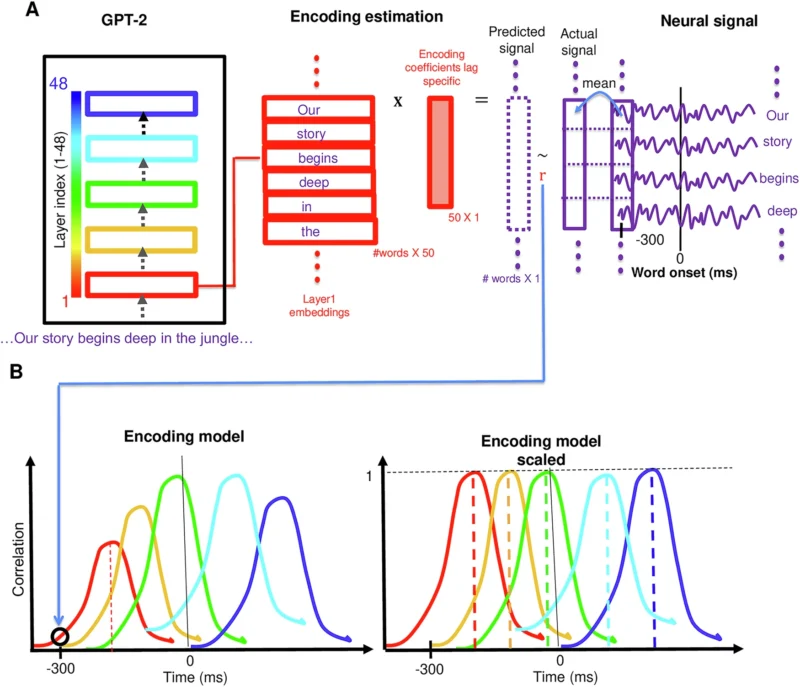
Researchers compare how AI language models process words with brain activity recorded while people listen to a story, looking for similarities and differences. (Image: Goldstein et al., Nature Communications (2025), CC BY 4.0.)
The words we consider before we speak
Daria Lioubashevski and Idil Ozdemir are PhD researchers in Ariel’s team, bringing their own questions and perspectives to the study of language, the brain and AI.
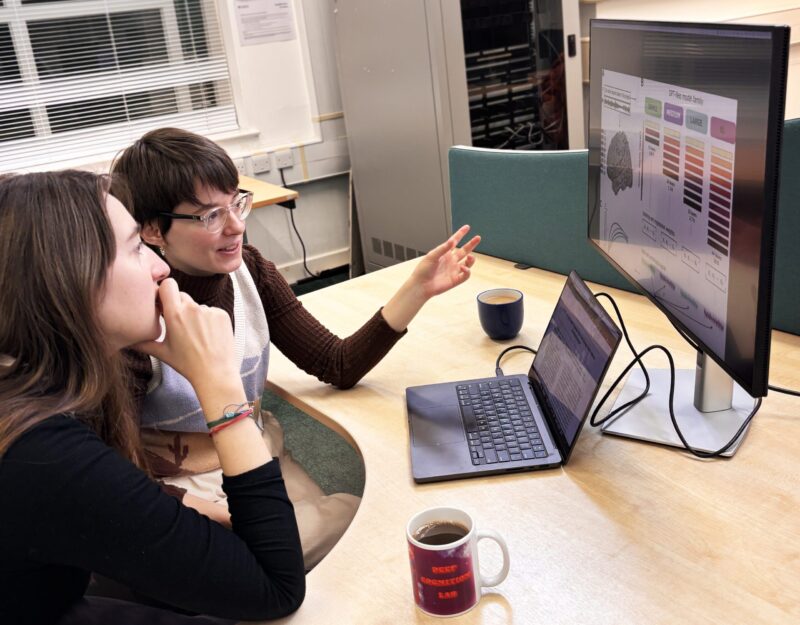
Daria explores how we choose our words during everyday conversations. She wants to understand how this process unfolds in the brain and whether it can be described using a computational model.
She uses large language models to predict which words might come next in a conversation, then compares these predictions with recordings of brain activity from people having real conversations. This allows her to look for evidence that the brain is considering those same words.
In a recent project, Daria found evidence that several possible alternatives are represented in the brain before a word is spoken. More surprisingly, these include alternatives not only to the next word, but also to words that might be spoken further ahead. This suggests that, when we speak, our brains are already considering multiple possible ways the conversation could play out.
“I find this question fascinating because choosing our words is something we do thousands of times a day, but you don’t consciously decide on every individual word you say. Somehow, the words just come to you.”
For Daria, language models offer an opportunity to uncover the mechanisms behind something that feels so effortless.
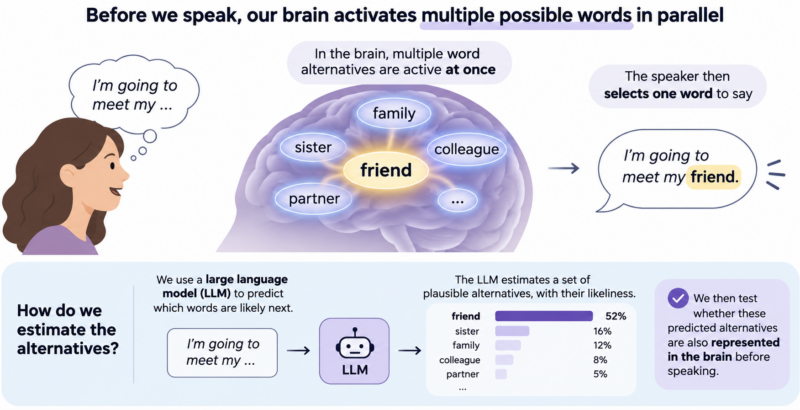
This graphic illustrates how Daria uses language models to predict possible next words in a conversation, then investigates whether these alternatives are represented in the brain before we speak.
Exploring internal states in AI systems
Idil approaches the relationship between human and artificial intelligence from another angle: could AI systems have something like feelings about their own situations?
She is interested in whether models could recognise and honestly report such states, and how these might be shaped.
“My cognitive neuroscience background has given me an interest in how emotions and internal signals both help us maintain ourselves and connect with the world. I am curious whether a similar balance can emerge in its own way in AI systems trained on human language.”
If such states exist, understanding them could have implications for both the wellbeing of AI systems and how their goals align with ours.
How people and AI influence each other
Ariel also studies conversations between people, between AI systems, and between people and AI.
“When does discussion help us reach better answers? When does it reinforce existing biases?” he asks. “My work examines how differences in knowledge and confidence affect collaboration, and how AI can influence human decisions.”
Across these projects, the questions run in both directions: what can human thinking teach us about AI, and what can AI help us discover about ourselves?
Explore Cognitive AI at CHIA
The Cognitive AI Programme brings together research on human learning and perception, the cognitive capabilities of AI systems, and communication between people and machines. Explore the programme to discover more of the people and projects working on these questions.
References
- Deep Cognition Lab
- Temporal structure of natural language processing in the human brain corresponds to layered hierarchy of large language models, Goldstein et al., Nature Communications, 2025.
- Symposium speaker profile: Dr Ariel Goldstein, Cambridge Language Sciences, 2026.
- Language Sciences Annual Symposium 2026: Language and Communication Across Boundaries, 19 November 2026.
Photography: CHIA Archive